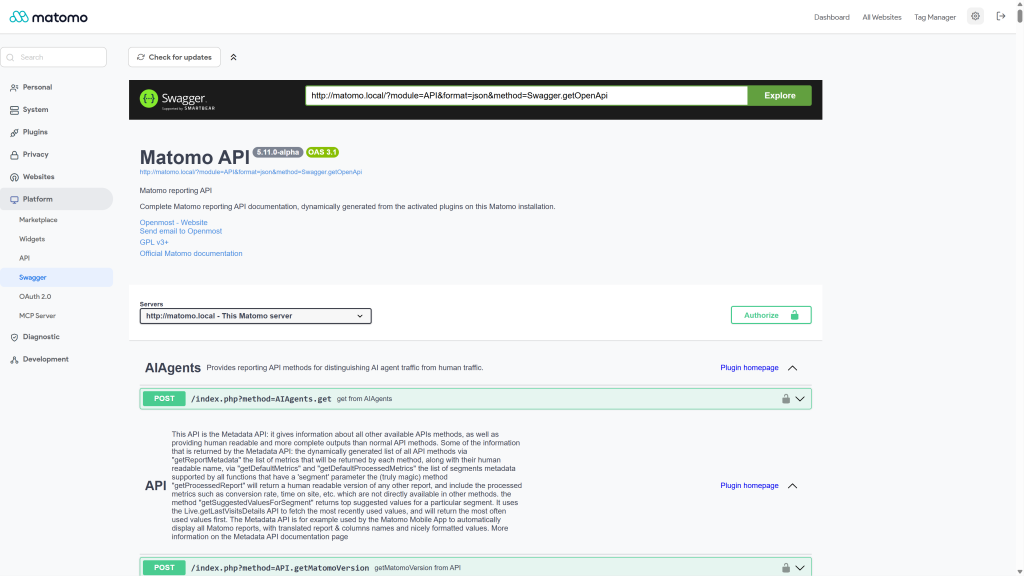
Explore and try every Matomo API method straight from your admin panel. Swagger adds an interactive API explorer to Matomo, powered by Swagger UI and an OpenAPI 3.1 specification generated live from the plugins activated on your Matomo.
No static file to maintain, no manual sync after installing or removing a plugin: open the page and every Reporting API method of your installation is there, documented and ready to call.
It is built for developers integrating with Matomo, support engineers debugging a setup, and anyone who would rather click "Try it out" than write curl commands by hand.
New in 6.0
- Matomo 6 ready: rebuilt on the Matomo 6 Vue components, with dark mode support.
- No token needed to try the API: requests are sent with your current Matomo session. Paste an API token with Authorize only when you want to test a specific token.
- Up to date Swagger UI (5.x) with a search field to filter the API modules.
- Method descriptions taken from the Matomo source code, with summaries and deprecation flags.
- Report parameters documented:
filter_limit, filter_sort_column, flat, format_metrics, showColumns and more on every report method.
- Download the OpenAPI JSON in one click, for Postman, Insomnia or an SDK generator.
- Embeddable as a Matomo widget with the Widgetize module.
-
A Swagger logo
-
Swagger
-
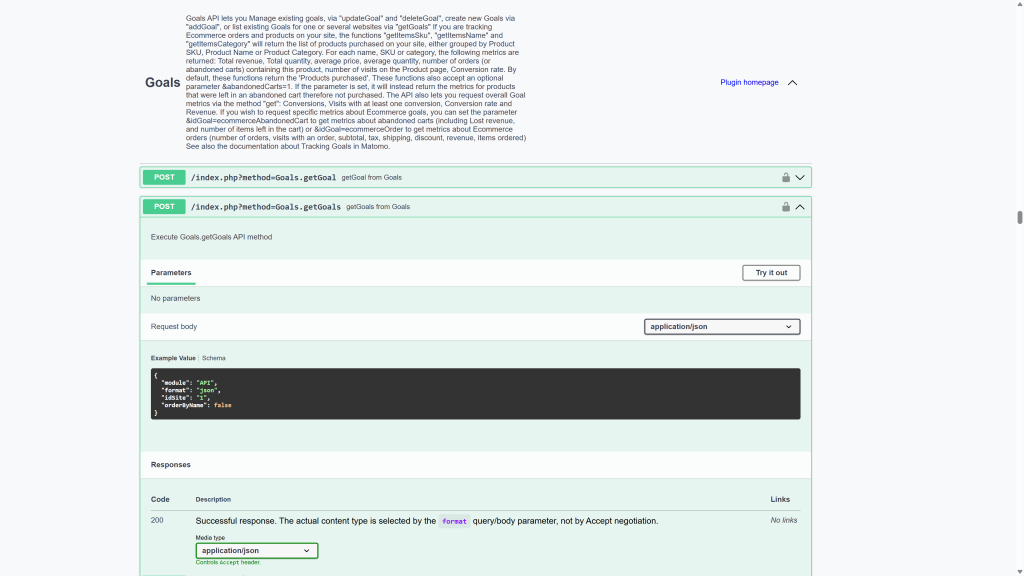
Swagger Goals API
1 - Install the plugin
Install this plugin from the Marketplace as a Super User, or download it and copy it to the /plugins folder of your Matomo.
Then activate the plugin under Administration > System > Plugins.
2 - Open the API explorer
As a Super User, go to Administration > Platform > Swagger.
The page lists every Reporting API module of your Matomo. Use the Filter by tag field to find a module, then expand it to see its methods. The specification is generated from the activated plugins each time the page is opened: when you activate or deactivate a plugin, its methods appear or disappear automatically.
3 - Try an API method
- Expand a method, for example
VisitsSummary.get.
- Click Try it out.
- Fill in the required parameters, marked with a red asterisk. Examples are suggested for
idSite, period and date.
- Click Execute to send the request and read the response.
Report methods also document the generic parameters applied by Matomo to every report: filter_limit, filter_offset, filter_sort_column, filter_sort_order, filter_pattern, showColumns, hideColumns, flat, format_metrics and percent_of_total.
4 - Choose how requests are authenticated
With your Matomo session (default)
The Send requests with my current Matomo session option sends your requests the same way the Matomo interface calls the API. No token is needed.
The curl command displayed after a request then contains your session token. This token only works together with your browser session, but avoid sharing screenshots of it.
With an API token
To check what a specific token is allowed to do:
- Untick Send requests with my current Matomo session.
- Click Authorize and paste an API token. Tokens are created under Administration > Personal > Security.
- Click Authorize, then Close.
The token is sent in the Authorization: Bearer header and is never stored by the plugin.
5 - Download the OpenAPI specification
Click Download OpenAPI JSON to save the specification, then import it in Postman, Insomnia, an API gateway or an SDK generator such as OpenAPI Generator.
The specification can also be requested with the Matomo API, using a Super User token:
curl -X POST "https://matomo.example.com/index.php" \
  -H "Authorization: Bearer YOUR_API_TOKEN" \
  -d "module=API" \
  -d "method=Swagger.getOpenApi" \
  -d "format=json"
6 - Embed the explorer (optional)
The explorer is also available as the Swagger API explorer widget, in the About Matomo category of the dashboard. It can be embedded in another tool with the Widgetize module:
<iframe
    src="https://matomo.example.com/index.php?module=Widgetize&action=iframe&moduleToWidgetize=Swagger&actionToWidgetize=getSwaggerUi&idSite=1&period=day&date=yesterday&disableLink=1&widget=1&token_auth=YOUR_API_TOKEN"
    width="100%"
    height="900"
    frameborder="0">
</iframe>
Only Super User tokens can load the widget. Anyone who can read the page embedding the iframe can use this token, so only embed it in private tools.
How the specification is built
- Every API method is described as a POST request on
index.php, with the method name in the path and the parameters in an application/x-www-form-urlencoded body.
- Parameter types come from the PHP signature of each method. Parameters without a default value are required.
- Array parameters are sent as
name[] fields, the format PHP expects.
- Summaries and descriptions come from the documentation of each method in the source code. Deprecated methods are flagged.
- The server URL is the URL you use to open Matomo, so the explorer also works when Matomo is installed in a subfolder.
- Matomo returns API errors with a 200 status code and a
result: error body.
Troubleshooting
The page shows "You can't access this resource"
The Swagger page requires Super User access.
A plugin's methods are missing
Check that the plugin is activated. Only the API methods of activated plugins are listed.
A request returns "token_auth is not valid"
The token entered with Authorize is invalid or revoked, or the session option is unticked while no token is authorized.
A request is slow or times out
Heavy reports can take time to process. Try a shorter period and date first, or lower filter_limit.
Which Matomo versions are supported?
Version 6.x of the plugin supports Matomo 6. For Matomo 5, install version 5.x of the plugin.
Who can use the API explorer?
Only Super Users. The explorer gives access to every API method, including administration methods, so it is restricted like the other platform tools.
Do I need an API token to try the API?
No. By default, requests are sent with your current Matomo session. Use the Authorize button when you want to test a specific API token.
Can I use a token restricted to POST requests?
Yes. Every method is called with a POST request and the token is sent in the Authorization: Bearer header.
Do I need to update anything when I install a new plugin?
No. The specification is generated from the activated plugins each time the explorer is opened.
Which OpenAPI version is generated?
OpenAPI 3.1.0.
Can I import the specification in Postman or generate an SDK?
Yes. Click Download OpenAPI JSON, or request the Swagger.getOpenApi API method with a Super User token. See the documentation for an example.
Why can't I send a JSON request body?
The Matomo API reads its parameters from the query string and form fields only, so the specification describes form requests.
Can I embed the explorer in another application?
Yes, with the Swagger API explorer widget and the Widgetize module. See the documentation for an example.
Does the plugin slow down Matomo?
No. Swagger UI is only loaded on the explorer page, and the specification is only generated when the explorer is opened.
Does the plugin store data?
No. It creates no database table and never stores tokens.